Can't Stop the Spiral? Science Just Explained Why.


Do you find yourself replaying the same thoughts in a loop? Research suggests that the answer may lie in how different brain networks communicate with each other.
Rumination- the tendency to repeatedly dwell on negative thoughts, emotions, or experiences, is a hallmark of depression and anxiety disorders. Rather than helping to solve problems, this repetitive thinking often fuels and prolongs psychological distress.
Research shows that rumination, is linked to changes in how major brain networks communicate with one another. This supports the triple network model of psychopathology, which suggests that disruptions in brain network connectivity are a common feature of many psychiatric and neurodevelopmental conditions.
1) The Default Mode Network (DMN): the regions of brain that are active when an individual is at rest. They help in self-reflection, planning for the future and evaluating ideas.
2) The Central Executive Network (CEN): Also known as frontoparietal network includes brain regions that support with tasks which require attention, problem solving and decision making.
3) The Salience Network: the brain regions that act like a switch between the DMN and CEN form part of the salience network. They help to prioritize important information and directs information effectively.
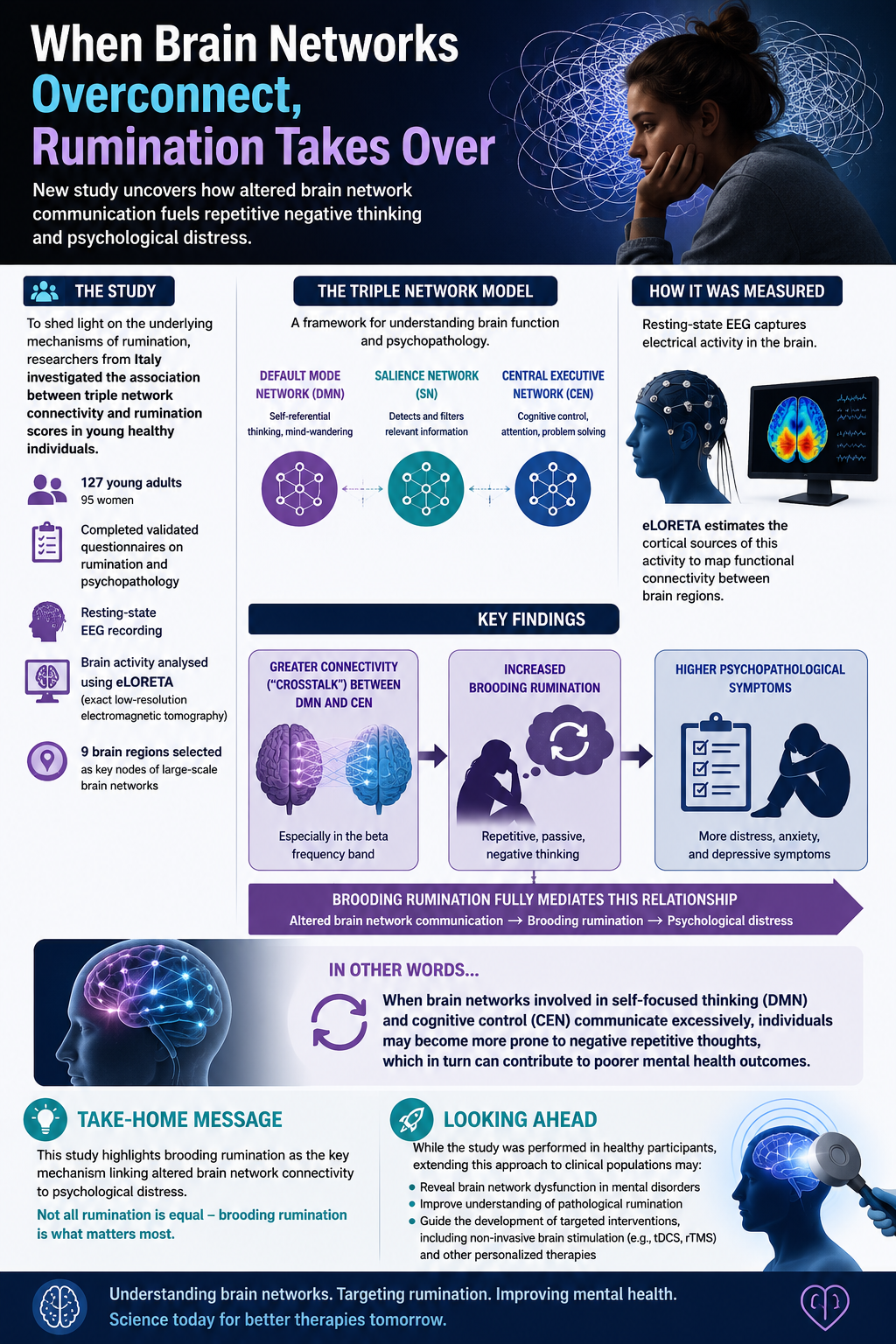
To shed light on the underlying mechanisms of rumination, researchers from Italy, investigated the association between triple network connectivity and rumination scores in young healthy individuals.
Published in the Journal of Affective Disorders, the study recruited 127 young adults, 95 of whom were women. Participants completed validated questionnaires assessing rumination and general psychopathology, followed by resting-state electroencephalography (EEG). Brain activity was analysed using eLORETA (exact low-resolution electromagnetic tomography), a widely used method for estimating the cortical sources of EEG activity. Based on previous research, the authors selected nine brain regions representing key nodes of large-scale brain networks.
The researchers found that greater functional connectivity, between the Default Mode Network (DMN) and the Central Executive Network (CEN) was associated with higher levels of psychopathological symptoms. Importantly, mediation analysis revealed that brooding rumination fully mediated this relationship, suggesting that altered communication between brain networks may contribute to psychological distress through an increased tendency to engage in repetitive negative thinking.
In other words, the study suggests that when brain networks involved in self-focused thinking and cognitive control communicate excessively, individuals may become more prone to negative repetitive thoughts, which in turn can contribute to poorer mental health outcomes.
While the study was performed in healthy participants, extending this approach to clinical populations may provide important insights into brain network dysfunction and pave the way for more targeted therapeutic interventions.
In reproductive mental health conditions such as Premenstrual Dysphoric Disorder, where symptoms and rumination fluctuate across the menstrual cycle, similar brain network approaches could help uncover the neural mechanisms underlying these changes. This, in turn, may pave the way for personalized neuromodulation strategies, such as tDCS and rTMS, to target pathological rumination and improve clinical outcomes.
Snapshot
Reference
Claudio Imperatori, Elena De Rossi, Giorgia Allegrini, Giuseppe Alessio Carbone, Simone Messerotti Benvenuti, Mauro Adenzato, Carola Dell'Acqua, Aurelia Lo Presti, Rita B. Ardito, Benedetto Farina. Brooding rumination as a mediator of the association between default mode and central executive network connectivity and general psychopathology: a resting state EEG study, Journal of Affective Disorders.