Postmenopausal ovaries: not empty just employed differently.


As medical advances extend women's lifespans, women today are living several years post their reproductive phase-around 42% of their lifespan on an average. This raises an intriguing evolutionary question: why do humans live so long after they stop having children?
One leading explanation is the grandmother hypothesis. Rather than continuing to have more children themselves, older women may have evolved to play a different but equally important role: helping the next generation thrive. By sharing knowledge and experience with their daughters and helping to care for their grandchildren, grandmothers can improve the survival and success of their family as a whole.
This idea recently gained support from a study by Ellis et al. published in Nature. By studying toothed whales, the researchers found that older females stop reproducing but continue living for many years. During this time, they help care for younger generations without competing with their daughters for resources or mates.
But what happens to the very organ that keeps women reproductively active-the ovaries?
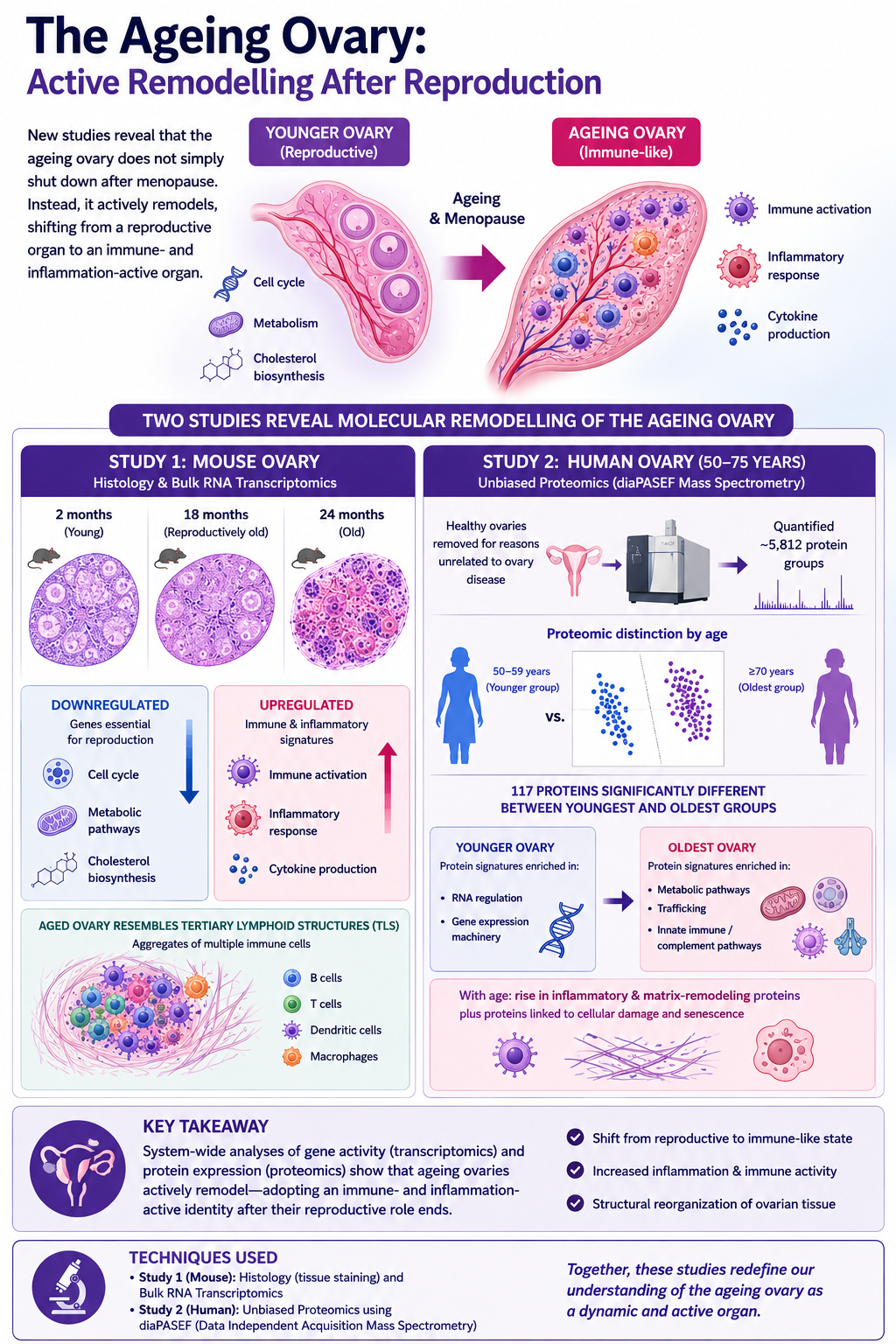
The longstanding view is that once women enter menopause, the level of reproductive hormones decline, and the ovary exists as a fibrous connective tissue. However, two new studies from Francesca Duncan's group at the Northwestern university are flipping that story.
In the first study conducted in female mice, both histology and Bulk RNA transcriptomics, comparing young (2months), reproductively old (18 months) and old (24 months mice) showed downregulation of genes involved in cell cycle, metabolic pathways and cholesterol biosynthesis. These are genes necessary for reproduction. On the other hand, gene enrichment analysis showed the upregulation of genes in immune activation, inflammatory response and cytokine production, all hallmarks of inflammation. The aged ovary resembled the features consistent with Tertiary lymphoid structures which are aggregates consisting of multiple immune cells.
The second study involved assessing healthy ovaries in women in age group of 50-75 years who had to undergo ovary removal for issues unrelated to ovary disease. To gain a comprehensive proteomics map of the aging ovaries, the study used an unbiased quantitative profiling approach-diaPASEF (Data independent acquisition mass spectrometry) . The team quantified around 5812 protein groups across the samples. Multiple statistical analysis tools displayed clear proteomic distinction between 50-59 and more than 70 years age groups.
117 proteins were significantly different between the youngest and oldest groups. With age, ovarian protein signatures shifted from RNA-regulation and gene-expression machinery (younger group) toward metabolic, trafficking, and innate immune/complement pathways (oldest group). There was a clear rise in inflammatory and matrix-remodeling proteins, plus proteins linked to cellular damage and senescence.
System-wide analyses of gene activity (transcriptomics) and protein expression (proteomics) reveal that ageing ovaries do not simply become inactive once their reproductive role ends. Instead, they continue to actively remodel themselves, adopting a markedly immune- and inflammatory profile.
In many ways, the ageing ovary mirrors the role of mothers and grandmothers themselves: once their primary role as mothers ends they adapt to support a new phase of life rather than simply shutting down.
Snapshot
References
1) Aubrey Converse, Shweta S Dipali, Ian P Schowe, Emmett B Kelly, Shivani S Jambunathan, Sarah R Ocañas, Michael B Stout, Michele T Pritchard, Francesca E Duncan, The post-reproductive ovary shifts from a reproductive to an immune-like organ, Molecular Human Reproduction, Volume 32, Issue 2, 2026, gaag038, https://doi.org/10.1093/molehr/gaag038
2) The human ovary exhibits dynamic molecular remodeling in the decades post-menopauseMark A. Watson, Bikem Soygur, Christina D. King, Pooja Raj Devrukhkar, Elisheva D. Shanes, Simon Melov, Mary Ellen G. Pavone, Francesca E. Duncan, Birgit Schilling bioRxiv 2026.03.26.714635; doi: https://doi.org/10.64898/2026.03.26.714635
3) Ellis, S., Franks, D.W., Nielsen, M.L.K. et al. The evolution of menopause in toothed whales. Nature 627, 579–585 (2024). https://doi.org/10.1038/s41586-024-07159-9