Same Mother, Different Brain: How a Second Pregnancy Rewires What the First One Started.


Becoming a mother activates profound physical and hormonal changes, but this transformation extends far beyond the body. Research shows that pregnancy reshapes the brain too, with significant reductions in grey matter volume. Rather than being harmful, these changes are thought to support a mother's ability to form a strong, healthy bond with her baby, helping her adapt to the demands of caregiving.
But what happens when a woman becomes pregnant for the second time? Does the brain simply repeat the same process, or does it adapt in a different way?
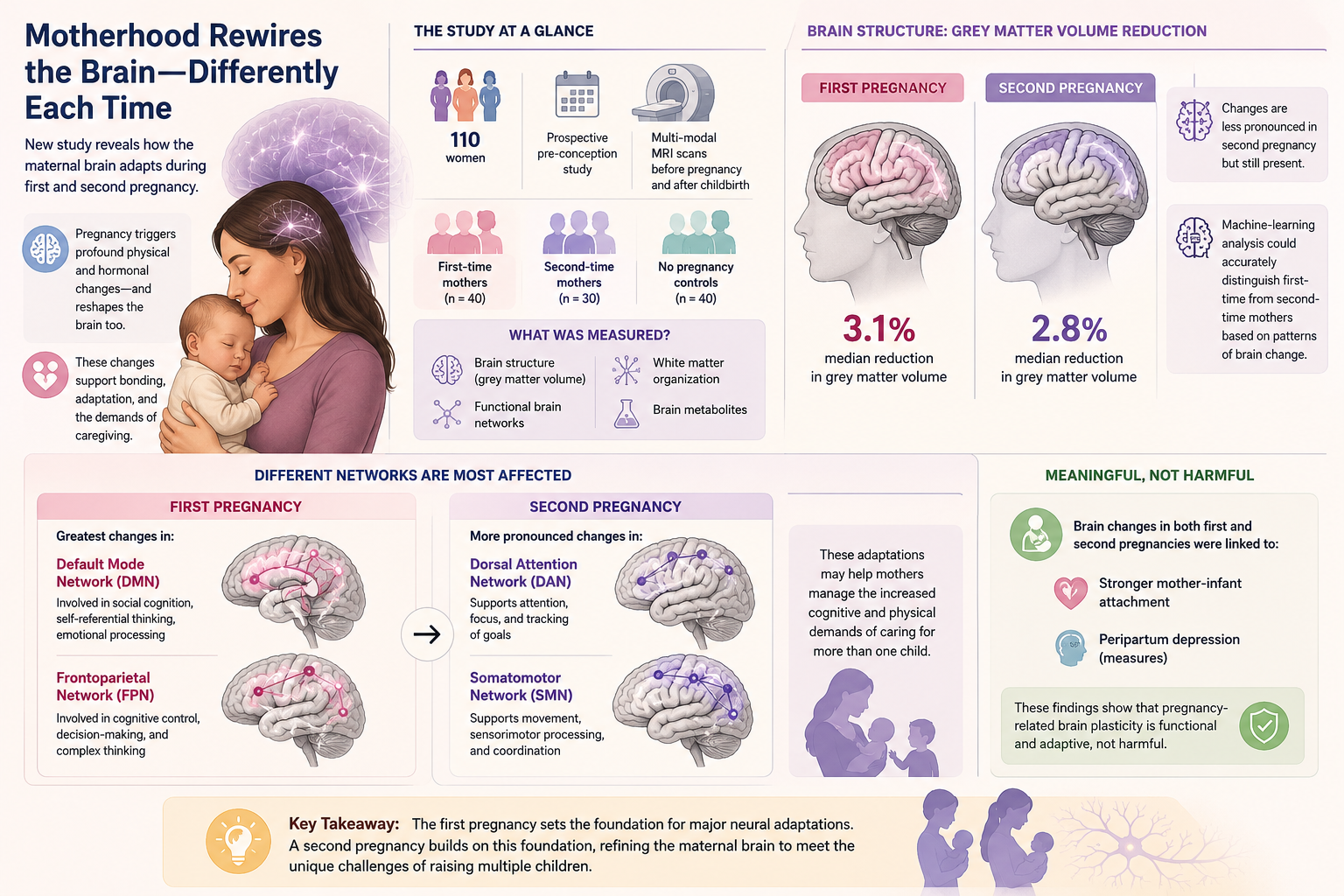
A new study published in Nature Communications sought to answer this question. Researchers followed 110 women in a prospective pre-conception study, including first-time mothers, second-time mothers, and women who did not become pregnant. Using multiple MRI techniques, they examined changes in brain structure, functional brain networks, white matter organization, and brain metabolites before pregnancy and after childbirth.
The findings showed that a second pregnancy also remodels the brain, but the changes are somewhat less pronounced than those seen during a first pregnancy. Women experiencing a second pregnancy showed a median 2.8% reduction in grey matter volume, compared with 3.1% in first-time mothers. Although the overall reduction was smaller, advanced machine-learning analyses revealed that the pattern of brain changes was distinct enough to accurately distinguish first-time from second-time mothers, suggesting that previous pregnancy experience influences how the brain adapts.
The study also uncovered differences in the brain networks that were most affected. During a first pregnancy, the largest changes occurred in the Default Mode Network (DMN) and Frontoparietal Network, regions involved in social cognition, self-referential thinking, and emotional processing. During a second pregnancy, these networks still changed but to a lesser extent. Instead, more pronounced changes were observed in the Dorsal Attention Network and Somatomotor Network, which support attention, movement, and processing of sensory information. The researchers suggest that these adaptations may help mothers manage the increased cognitive and physical demands of caring for more than one child.
Importantly, the researchers found that brain changes associated with both first and second pregnancies were related to measures of mother-infant attachment and peripartum depression, reinforcing the idea that pregnancy-induced brain plasticity is functionally meaningful rather than harmful. Overall, the findings suggest that while the first pregnancy establishes major neural adaptations, a second pregnancy further refines the maternal brain to meet the challenges of raising multiple children.
Snapshot
Reference
Straathof, M., Halmans, S., Pouwels, P.J.W. et al. The effects of a second pregnancy on women’s brain structure and function. Nat Commun 17, 1495 (2026). https://doi.org/10.1038/s41467-026-69370-8