Nature, nurture, and new motherhood: what twins reveal about postpartum depression


Perinatal depression is a mood disorder that affects approximately 1 in 7 individuals during pregnancy or within the first year following childbirth. Unlike “baby blues,” symptoms of perinatal depression are more severe, persistent, and can last for several months. If left untreated, perinatal depression can result in significant psychological distress for the mother, interfere with mother-infant bonding, and potentially contribute to long-term developmental difficulties for the child.
Despite its prevalence and potential impact, many women experiencing postpartum depression (PPD) do not seek professional help due to the stigma and shame associated with the condition. New mothers are often subjected to unrealistic societal expectations, to feel consistently happy and fulfilled following the birth of their child. Although motherhood undoubtedly brings immense joy, it can be accompanied by feelings of hopelessness and distress for some individuals. There is a range of genetic, social, and environmental factors that contribute to postpartum depression. Developing a better understanding of these diverse factors is therefore an important step towards improving the identification, care, and support provided to new mothers, while also promoting healthy development and well-being for their infants.
Both genetic and environmental factors contribute to the risk of postpartum depression, as evidenced by various meta-analyses, genome-wide association studies, as well as twin studies. Studies on twins have historically estimated heritability and help to quantify biological risk. Heritability is a statistical measure to assess how much variation of a specific trait in a population is due to genetic differences rather than environmental factors.
In a recent twin study in a Danish population, the researchers aimed to estimate the heritability of PPD and examine the relative contribution of familial and individual environment.
The data used in the study was obtained from the Danish Twin Registry and the Danish National Health Registry. Importantly, the study relied on clinically diagnosed cases and treatment records rather than self-reported or retrospectively recalled symptoms. The analysis included female twin pairs where both twins had given birth to at least one child; PPD was assessed within the first year after childbirth in the main analysis, with 6-month and broader psychiatric-diagnosis windows used in sensitivity analyses.
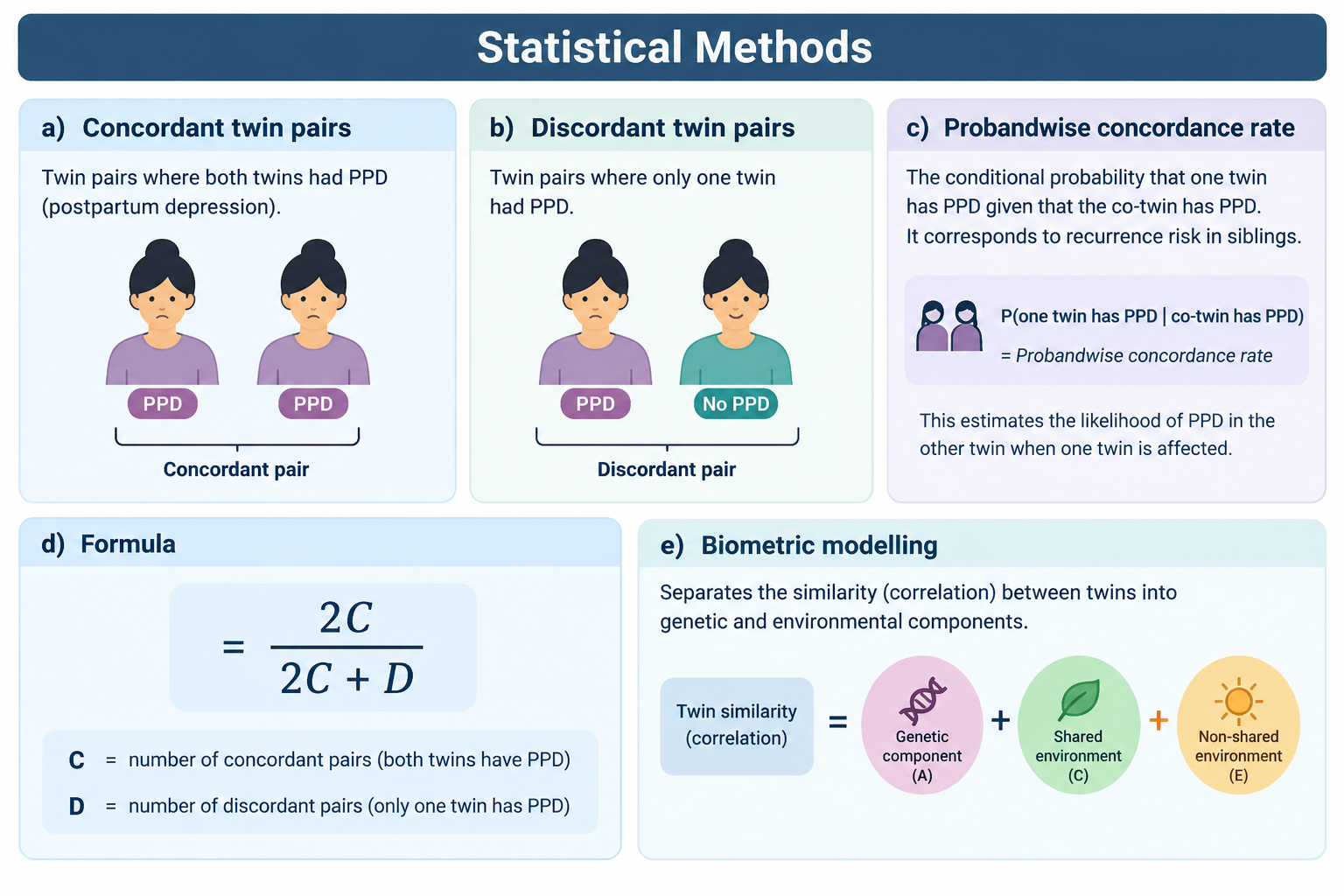
A classical twin study design was employed to estimate the genetic contribution to PPD. This approach assumes that monozygotic (MZ) twins share virtually 100% of their genetic variants, whereas dizygotic (DZ) twins share, on average, approximately 50% of their segregating genetic variants. Differences in the similarity of PPD outcomes between MZ and DZ twin pairs can therefore be used to estimate the heritability of the condition.
The breakdown below shows twin concordance for PPD, the descriptive step underlying the heritability estimate:
A total of 10,418 females qualified for the study, which included: 4236 (monozygotic twins); 4946 (dizygotic twins); and 1236 (unknown zygosity). The median age of participants was 27 years, with 6.5% having a history of depression and 14.5% having a history of psychiatric disorder before childbirth.
Following the birth of the child, 2.2% had a diagnosis of depression, 2.5% had a psychiatric disorder within 6 months, and 3.6% were diagnosed within 1 year.
The main analysis included the following data:
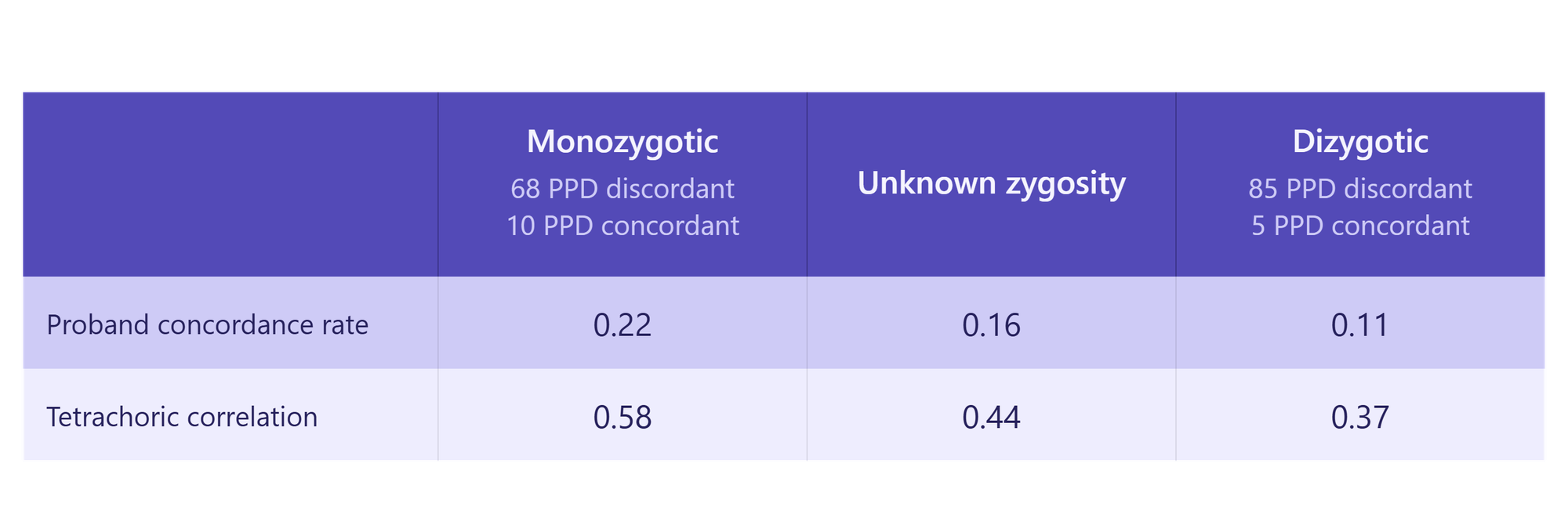
The liability threshold model provided the best fit for analysing the study design, indicating that a model incorporating both additive genetic and unique environmental effects provided the most appropriate fit to the data.
Based on this model, 60% of the variance (95% CI: 46–75%) was attributable to heritable factors, while the remaining 40% was explained by unique environmental factors. Sensitivity analyses estimated the heritability of PPD at 52% when defined as any psychiatric disorder occurring within one year after childbirth, and 60% when defined as any psychiatric diagnosis within six months. These estimates are notably higher than the estimated heritability of major depressive disorder (37%). However, the authors caution that comparisons across studies using different populations, definitions, and methodologies should be interpreted as suggestive rather than conclusive.
The study highlights the importance of identifying and understanding the risk factors associated with postpartum depression (PPD), using a classical twin study design to examine the relative contributions of genetic and environmental influences. The findings suggest that both genetic and environmental factors play a significant role in the risk of developing PPD, emphasising the need for greater awareness and access to reliable resources about the condition. Accessible mental health services, alongside adequate support from family members and workplaces, can play an important role in supporting new mothers during this vulnerable period. Providing appropriate care and support can not only improve maternal mental health and well-being but may also promote healthier outcomes for the infant.
Reference
Mette Bliddal, Sofie Egsgaard, Carolyn E. Cesta, Dorthe A. Pedersen, Sören Möller, Kaare Christensen, Trine Munk-Olsen. Heritability of postpartum depression in female twin pairs: A Danish population-based cohort study, Journal of Affective Disorders, 2026.


