Switching off brain estrogen in mice: a new window into why women's memory and mood decline with age


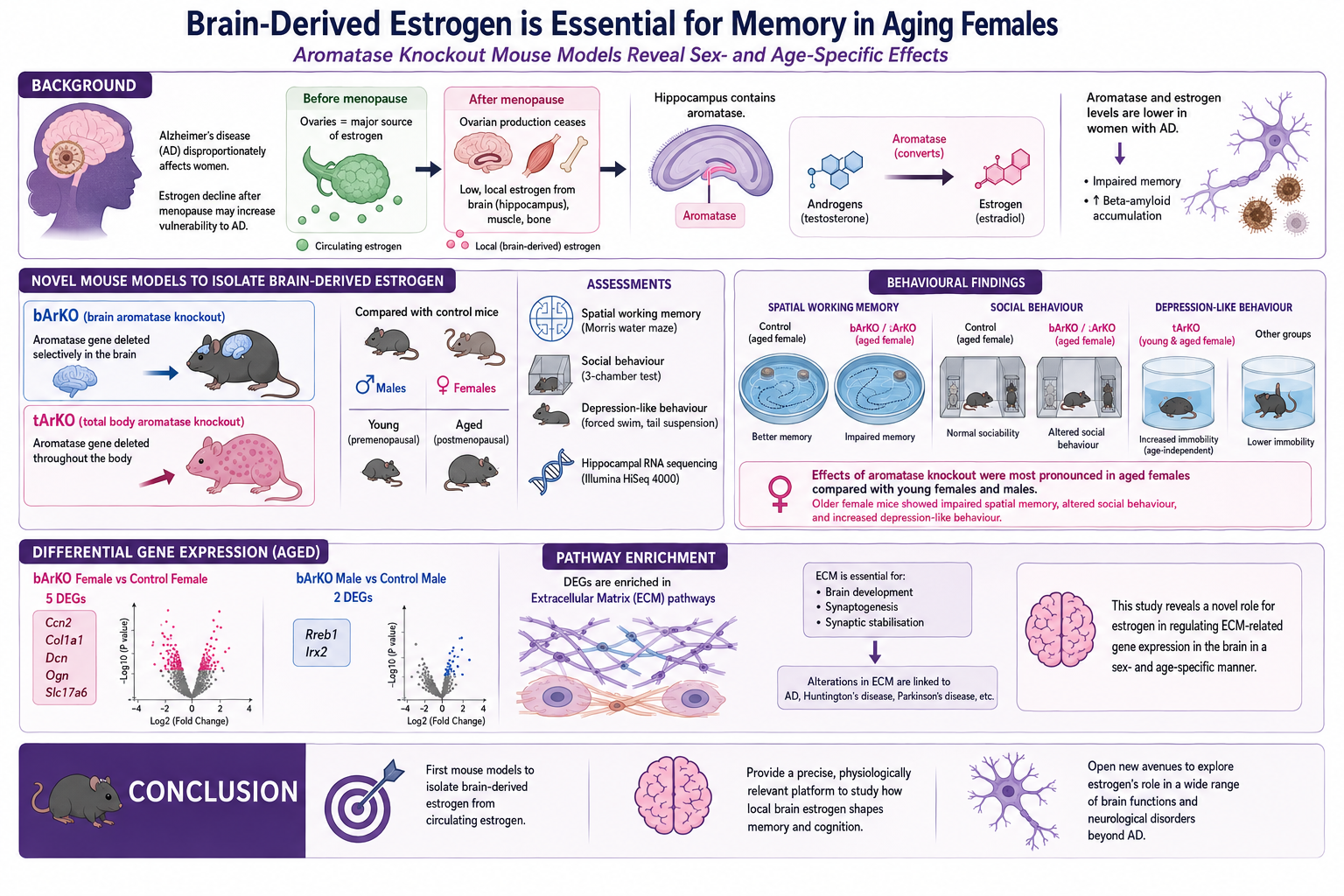
Alzheimer’s disease (AD) is a progressive neurodegenerative disorder and the leading cause of dementia worldwide. Women are disproportionately affected by AD partly because they tend to live longer than men. As life expectancy increases, women spend a substantial portion of their lives in the postmenopausal period. Growing evidence suggests that the decline in estrogen following menopause may contribute to this increased vulnerability to AD, as estrogen plays a key role in supporting brain health through its neuroprotective effects.
The exact mechanism by which estrogen loss affects memory in ageing women remains poorly understood. Before menopause, the ovaries are the primary source of circulating estrogen. Post-menopause, ovarian production ceases, and only small, localised amounts of estrogen are produced in the brain, muscles, and bone. Within the brain, the hippocampus, the region central to memory and recognition, produces estrogen locally via the enzyme aromatase.
Interestingly, the levels of both the enzyme aromatase and estrogen are found to be lower in women with AD as compared to healthy controls. And inhibition of aromatase in female mice - either through specific inhibitors or aromatase knockout - impairs memory and exacerbates beta-amyloid accumulation in the hippocampus, respectively.
To better understand the role of estrogen in memory and cognitive function, researchers at Northwestern University developed two genetically modified mouse models. In one model, the aromatase gene was selectively deleted in the brain (bArKO), while in the other, aromatase was eliminated throughout the entire body (tArKO). Both models were compared with control mice in males and females to investigate sex-specific effects. The researchers also examined young and aged mice to model the premenopausal and postmenopausal stages of the human lifespan, providing insight into how brain-derived estrogen influences cognition across ageing.
Memory and AD-related affective behaviours between different mouse groups were compared using a range of standard tests. Bulk RNA from the hippocampus was isolated, and sequencing was performed using the Illumina HiSeq 4000 sequencing system.
The effects of aromatase gene knockout in both the brain and the whole body were most pronounced in aged females compared with both young females and males. Older female mice exhibited impaired spatial working memory and altered social behaviour. Notably, depression-like behaviour was observed in both young and aged female tArKO mice, suggesting this effect is independent of age. Differential gene analysis between aged bArKO female and its age-and sex-matched control identified five differentially expressed genes (DEGs): Ccn2, Col1a1, Dcn, Ogn, and Slc17a6, whereas 2 DEGs were identified in male bArKO mice: Rreb1, Irx2.
Gene enrichment analysis of these DEGs revealed enrichment of extracellular matrix (ECM) pathways. The ECM is synthesised and secreted by neurons and plays a key role in brain development, synaptogenesis, and synaptic stabilisation. As synaptic plasticity and remodelling are fundamental to learning and memory, ECM molecules are critical regulators of cognitive function. Notably, alterations in ECM- including degradation, overproduction, and changes in the composition of key components- have been observed in neurodegenerative diseases such as AD, Huntington's disease, and Parkinson's disease. While estrogen's role in regulating ECM in peripheral tissues is well established, this study provides novel evidence of its influence on ECM-related gene expression in the brain in a sex- and age-specific manner.
This novel mouse model is the first to isolate the contribution of brain-derived estrogen from circulating estrogen, offering a physiologically relevant tool to study how local brain estrogen shapes memory and cognition. Beyond AD, it opens the door to exploring estrogen's influence across a broader range of brain functions and neurological conditions.
Snapshot
Reference
Piehl, N. C., A. W. Halle, G. Rodriguez, et al. 2026. “Loss of Brain-Derived Estrogen Is Associated With Sex- and Age-Dependent Alterations in Memory, Affective Behavior, and Hippocampal Extracellular Matrix Gene Expression.” Aging Cell25, no. 6: e70551. https://doi.org/10.1111/acel.70551.


