Cycle tracking, redefined—accurate insights from a single blood draw.


Historically, clinicians have relied on patient-reported cycle dates or hormonal profiling to estimate menstrual cycle phase. While these approaches provide a useful starting point for clinical decision-making, due to the subjective nature of self-reporting and the variability introduced by irregular cycles, their accuracy is limited. There is a growing need for a more objective, robust, and precise measure of cycle timing.
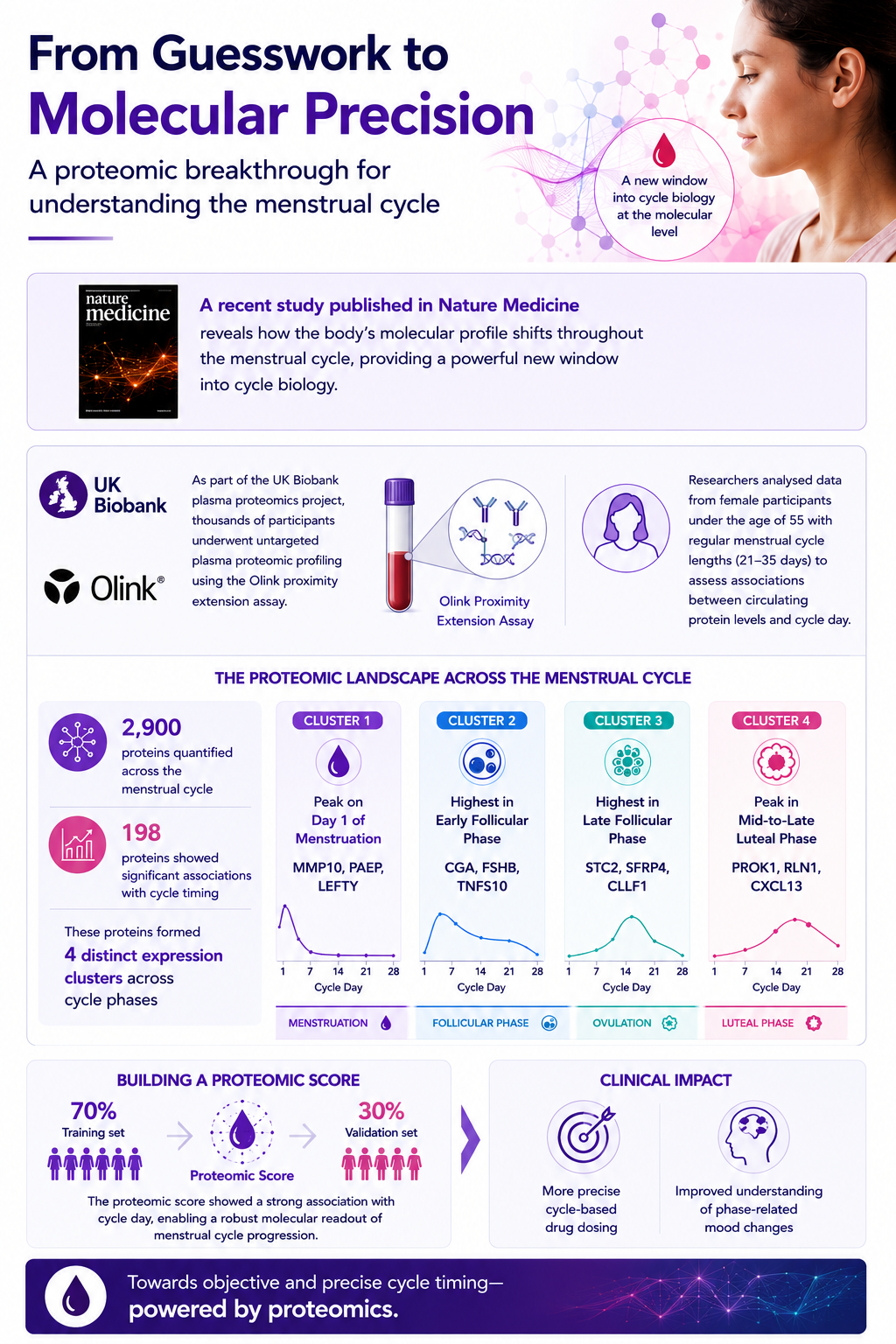
A recent study published in Nature Medicine reveals how the body's molecular profile shifts throughout the menstrual cycle, providing a powerful new window into cycle biology.
As part of the UK Biobank Plasma Proteomics Project, approximately 54,000 participants underwent untargeted plasma proteomic profiling using the Olink Proximity Extension Assay. Researchers analysed data from 2,760 women with regular menstrual cycle lengths of 21–35 days, assessing associations between circulating protein levels and self-reported cycle day.
A total of 2,900 proteins were quantified across the menstrual cycle, of which 198 showed significant associations with cycle timing. Expression patterns of these proteins varied systematically across cycle phases, enabling the identification of four distinct clusters.
Cluster 1 comprised proteins with peak expression on day 1 of menstruation, including MMP10, PAEP, and LEFTY. Cluster 2 showed the highest expression during the early follicular phase, including CGA, FSHB, and TNFS10. Cluster 3 peaked in the late follicular phase, with proteins such as STC2, SFRP4, and CLLF1. Finally, Cluster 4 demonstrated peak expression during the mid-to-late luteal phase, including PROK1, RLN1, and CXCL13.
Several proteins were linked to common reproductive disorders, including endometriosis, leiomyoma, and abnormal bleeding. Using Mendelian randomisation, the researchers found evidence that higher levels of FSHB (a component of follicle-stimulating hormone) may causally increase the risk of endometriosis.
Data from 70% of participants were used to train a LASSO regression model, identifying 75 proteins with non-zero coefficients. The resulting proteomic score was validated in the remaining 30% of the cohort, where it showed a strong correlation with cycle day and explained substantially more variance in cycle timing than estradiol alone. This multi-protein signature provides a robust molecular readout of menstrual cycle progression from a single blood sample.
This powerful approach may pave the way for more precise non-invasive cycle-informed therapeutic strategies and substantially deepen the understanding of phase-related physiological and mood changes.
Snapshot
Reference: Riishede, I., Rode, L., Lundegaard, P.R. et al. Plasma proteomic signature of the human menstrual cycle. Nat Med (2026). https://doi.org/10.1038/s41591-026-04326-5